Solving the Chicken-and-Egg Problem for Tokenized Real Estate

Mantasha Tarannum
Use Cases
4
min read
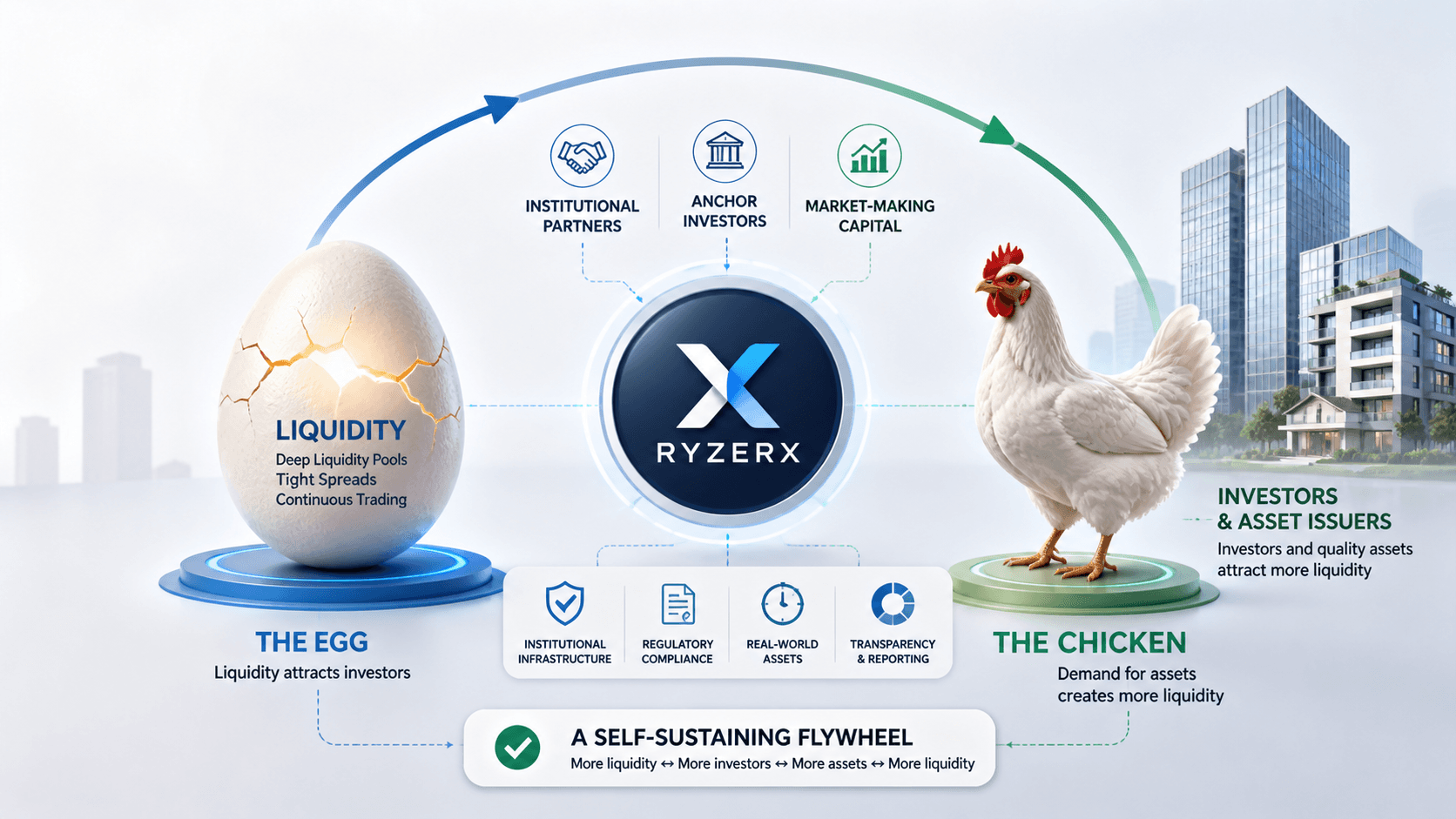
The distribution bottleneck is not a technology problem — it is a business development and capital deployment problem. The solution has three components:
Institutional Partner Program — Recruit 15–25 licensed intermediaries (broker-dealers, RIAs, IFAs, wealth managers) across 5 jurisdictions who distribute RyzerX tokens to their clients
Market-Making Capital — Deploy $5M–$10M in market-making capital to ensure tight spreads (0.5%–1%) and continuous liquidity
Anchor Investor Program — Pre-commit 20–30% of each deal to institutional anchor investors before public launch
Expected Outcome: Assets close 50% of their raise within 72 hours of launch, 80%+ within 30 days.
Timeline: 12 months to full deployment, 6 months to first institutional partners live.
Capital Required: $2M–$3M (partner recruitment, market-making, technology integration, legal/compliance).
Part 1: The Institutional Partner Program
1.1 Partner Tiers & Commission Structure
Create a 5-tier partner program with increasing benefits and commission rates:
Tier | Name | Entry Criteria | Commission | Benefits | Target Count |
|---|---|---|---|---|---|
Tier 1 | Bronze | $1M–$5M AUM | 0.75% | Basic API, monthly reporting | 5–8 |
Tier 2 | Silver | $5M–$20M AUM | 1.0% | Priority support, quarterly training | 5–8 |
Tier 3 | Gold | $20M–$50M AUM | 1.25% | White-label portal, co-marketing | 3–5 |
Tier 4 | Platinum | $50M–$100M AUM | 1.5% | Custom API, dedicated account manager | 2–3 |
Tier 5 | Diamond | $100M+ AUM | 1.75% + equity option | Full integration, board seat option | 1–2 |
Commission Model:
Base commission: 1% of capital raised through partner
Performance bonus: +0.25% if partner places $5M+ in a single deal
Retention bonus: +0.25% if capital stays invested for 12+ months
Referral bonus: 0.5% of capital raised from partner's referrals
Example: A Silver partner places $10M in a deal and $8M stays invested for 12 months:
Base: $10M × 1.0% = $100K
Performance: $10M × 0.25% = $25K
Retention: $8M × 0.25% = $20K
Total: $145K for one deal
1.2 Partner Recruitment Strategy
Phase 1: Identify & Qualify (Months 1–2)
Target profile:
Broker-dealers: Licensed to sell securities, existing client base of 100–5,000+ HNI/institutional investors
RIAs (Registered Investment Advisors): Licensed to manage discretionary portfolios, $50M–$500M AUM
IFAs (Independent Financial Advisors): Licensed to advise on investments, existing client relationships
Wealth managers: Licensed to manage wealth, institutional and HNI clients
Family offices: Manage $100M–$1B+ for ultra-HNI families, looking for alternative assets
Geographic Priority:
UAE (ADGM): 40–50 licensed broker-dealers, 20–30 RIAs
India (SEBI): 100+ licensed broker-dealers, 50+ RIAs
UK (FCA): 200+ licensed wealth managers, 100+ RIAs
USA (SEC): 1000+ RIAs, 100+ broker-dealers
Thailand (BOT): 20–30 licensed wealth managers
Recruitment Channels:
Direct outreach via LinkedIn (CEO to CEO)
Industry conferences (Wealth Management Summit, Alternative Investments Forum, Tokenization Conference)
Broker association partnerships (ADGM Association, SEBI-registered brokers, FCA-regulated firms)
Referrals from existing partners
Fintech accelerators and venture networks
Qualification Criteria:
✓ Licensed and regulated in target jurisdiction
✓ Existing client base of 100+ HNI/institutional investors
✓ Demonstrated interest in alternative assets (private equity, hedge funds, real estate)
✓ Technology capability (API integration, reporting systems)
✓ Willingness to co-market RyzerX to their clients
Phase 2: Pitch & Close (Months 2–6)
Pitch Deck Content:
The problem: Real estate is illiquid, tokenization is fragmented, investors want exposure
The solution: City Index model, continuous trading, institutional-grade infrastructure
The opportunity: $4T market by 2035, first-mover advantage, 1.5% AUM commission
The proof: Lofty.ai (673 properties, $100M+ AUM), 21Shares BOLD (60+ partners), REIT ETF model
The roadmap: 10–20 deals in Year 1, $100M AUM by Year 3, $1B+ by Year 5
The partner benefits: White-label portal, co-marketing, dedicated support, equity option
Close Strategy:
Offer a pilot program: 1–2 deals with reduced commission (0.5%) to prove the model works
Provide turnkey marketing materials: Investor deck, risk assessment, compliance memo (generated by Manus Agent)
Offer dedicated onboarding: 2–4 weeks of training and support to get the partner's team up to speed
Provide performance guarantees: If a deal does not close within 60 days, RyzerX buys back the unsold portion at 98% of issue price
Target: Sign 5–8 Bronze/Silver partners in Months 2–6.
1.3 Partner Enablement & Support
Technology Integration:
API Access: Partners can query deal pipeline, investor accreditation status, NAV, yield distributions
White-Label Portal: Partners can embed RyzerX trading in their own website (for Gold+ partners)
Reporting Dashboard: Real-time commission tracking, investor performance, deal status
Document Generation: Manus Agent auto-generates investor deck, risk assessment, compliance memo for each deal
Training & Onboarding:
Week 1: Product training (City Index model, trading mechanics, settlement process)
Week 2: Compliance training (KYC/AML, accreditation verification, regulatory requirements per jurisdiction)
Week 3: Sales training (investor pitch, objection handling, deal structuring)
Week 4: Technical training (API integration, reporting, troubleshooting)
Ongoing Support:
Monthly calls: Deal pipeline review, performance metrics, feedback
Quarterly training: New product features, market updates, best practices
Annual conference: Partner summit, networking, incentive awards
Dedicated account manager: For Gold+ partners
Part 2: Market-Making Capital Deployment
2.1 Market-Making Strategy
The Problem:
A city index with $10M in liquidity pools but $100M in outstanding tokens will have wide spreads (2–5%) and low trading volume. Investors will not trade because they lose 2–5% on every transaction.
The Solution:
Deploy $5M–$10M in market-making capital to:
Provide continuous bid/ask quotes (0.5%–1% spread)
Absorb temporary imbalances (when sellers outnumber buyers)
Stabilize NAV around the fundamental value
Encourage retail trading (tight spreads = more traders)
Market-Making Model:
Use Robo-Trader algorithm (already built in RyzerX) to provide continuous quotes
Set spread at 0.5%–1% (vs. 2–5% without market-making)
Market maker earns the spread: 0.5% × $100M AUM × 10 trades/year = $50K–$100K/year
Market maker also earns yield: 5%–8% on $5M capital = $250K–$400K/year
Total market-maker revenue: $300K–$500K/year
Capital Deployment:
Deploy $1M–$2M per city index (HYD, BLR, MUM, etc.)
Total deployment: $5M–$10M across 5–10 city indexes
Market maker holds tokens to provide liquidity (not trading them)
Market maker earns yield on holdings + spread income
2.2 Market-Making Capital Sources
Option 1: RyzerX Internal Capital (Recommended)
Use platform revenue or venture capital to fund market-making
Pros: Full control, no external dependencies, builds long-term value
Cons: Requires capital, ties up balance sheet
Recommendation: Allocate $5M–$10M from Series A/B funding
Option 2: External Market-Making Firms
Partner with existing market-making firms (Wintermute, Amber Group, etc.)
Pros: No capital required, experienced operators
Cons: Expensive (2–3% of AUM), lose control of liquidity
Recommendation: Use for initial pilot (1–2 city indexes), then transition to internal
Option 3: Yield-Farming Partners
Partner with DeFi lending protocols (Morpho, Maple Finance) to provide market-making capital
Pros: Capital is productive (earns yield), partners benefit from token appreciation
Cons: Requires DeFi integration, more complex
Recommendation: Use for Year 2+ after DeFi integration is complete
Option 4: Institutional Anchor Investors
Recruit 3–5 institutional anchor investors who commit $1M–$2M each to provide liquidity
Pros: Aligned incentives, institutional credibility
Cons: Requires finding and convincing anchors, dilutes returns
Recommendation: Use as secondary source after internal capital is deployed
2.3 Market-Making Performance Metrics
Track and optimize:
Spread: Target 0.5%–1% (vs. 2–5% without market-making)
Turnover: Target 5–10 trades per token per month (vs. 1–2 without market-making)
NAV stability: Target ±2% deviation from fundamental value (vs. ±5%+ without market-making)
Liquidity depth: Target $100K–$500K available at best bid/ask (vs. $10K–$50K without market-making)
Part 3: Anchor Investor Program
3.1 Anchor Investor Strategy
The Problem:
A new deal launching with no pre-committed capital will struggle to attract early investors. Early investors are risk-averse and want proof that others have already invested.
The Solution:
Pre-commit 20–30% of each deal to institutional anchor investors before public launch. This:
De-risks the deal (guarantees minimum capital raise)
Signals credibility to retail investors
Accelerates capital raise (50% in 72 hours, 80% in 30 days)
Reduces marketing costs (anchors bring their own networks)
3.2 Anchor Investor Profile
Target:
Institutional investors: Pension funds, insurance companies, endowments, family offices
Allocation: $500K–$5M per deal
Hold period: 12–36 months (not trading, holding for yield)
Geography: UAE, India, UK, USA, Thailand
Minimum AUM: $100M+
Recruitment Channels:
Direct outreach via institutional investor networks
Conferences (Institutional Investor Summit, Alternative Investments Forum)
Broker partnerships (institutional sales teams)
Venture capital networks (LPs who are also interested in real estate)
3.3 Anchor Investor Terms
Incentive Structure:
Base yield: Same as retail investors (6%–8%)
Anchor bonus: +1%–2% for committing capital before public launch
Lock-up discount: 10% discount on token price for 12–24 month hold
Governance rights: Seat on deal advisory board, quarterly reporting
Example:
Anchor investor commits $2M to HYD-RENT deal
Base yield: 7% = $140K/year
Anchor bonus: 1.5% = $30K/year
Lock-up discount: 10% = $200K upfront savings
Total value: $370K/year + $200K upfront
3.4 Anchor Investor Recruitment Timeline
Month 1: Identify 20–30 target anchor investors
Month 2: Pitch to 10–15 anchors, close 3–5 anchors for pilot deal
Month 3: Deploy pilot deal with anchor capital, track performance
Month 4–6: Scale to 5–10 anchors per deal, close 2–3 deals with anchor capital
Part 4: Integration with Manus Agent
4.1 Manus Agent as Distribution Accelerator
The Manus Agent already produces:
L0 output: Risk score, Go/No-Go verdict
L1–L5 outputs: Financial model, legal framework, compliance architecture, distribution strategy, technology blueprint
New capability needed: Document auto-generation
Documents to generate:
Investor Deck (20–30 slides)
Executive summary
Property details and financials
Risk assessment and mitigation
Market analysis and comparables
Investment highlights and use of proceeds
Team and track record
Terms and conditions
Risk Assessment Certificate (2–3 pages)
Manus Agent risk score and verdict
200+ data points analyzed
Risk factors and mitigations
Comparable deals and benchmarks
Certification by Manus (for credibility)
Compliance Memo (5–10 pages)
Jurisdiction-specific regulatory requirements
KYC/AML procedures
Accreditation verification
Offering document compliance (PPM, Subscription Agreement)
Ongoing compliance obligations
Deal Brief (1–2 pages)
One-page summary for partner distribution
Key metrics (yield, risk score, capital raise target)
Investment highlights
Call-to-action (link to investor deck)
4.2 Document Generation Workflow
Current state: Manus Agent outputs JSON for each layer
New state: Manus Agent generates:
Structured JSON (same as today)
Formatted PDF documents (investor deck, risk certificate, compliance memo)
Auto-populated Word documents (for legal review and customization)
Implementation:
Use LibreOffice/Python to convert JSON → PDF/DOCX
Use Jinja2 templates for document formatting
Use Manus LLM to generate narrative sections (executive summary, risk analysis, investment highlights)
Store documents in S3 for partner download
Timeline: 2–4 weeks to implement
4.3 Partner Portal Integration
New feature: Partners can access:
Deal pipeline (upcoming deals, capital raise targets, risk scores)
Investor deck and compliance memo (auto-generated by Manus Agent)
Commission tracking (real-time, per deal)
Investor management (KYC status, accreditation verification, portfolio)
Reporting (investor performance, deal status, yield distributions)
Implementation:
Add Partner Dashboard to RyzerX admin panel
Integrate Manus Agent document generation
Build API endpoints for partner access
Add white-label portal for Gold+ partners
Timeline: 4–8 weeks to implement
Part 5: Go-to-Market Timeline
Phase 1: Foundation (Months 1–3)
Objectives:
Finalize partner program terms and incentive structure
Identify and qualify 20–30 target partners
Deploy $2M–$3M in market-making capital
Recruit 3–5 anchor investors for pilot deal
Deliverables:
Partner program documentation (tier structure, commission model, terms)
Partner recruitment playbook (pitch deck, qualification criteria, outreach strategy)
Market-making capital deployment plan
Anchor investor recruitment playbook
Metrics:
20–30 partners identified and qualified
3–5 anchor investors committed
$2M–$3M market-making capital deployed
1 pilot deal launched with anchor capital
Phase 2: Pilot & Validation (Months 4–6)
Objectives:
Launch pilot deal with 3–5 anchor investors
Sign 5–8 Bronze/Silver partners
Validate market-making spreads and trading volume
Integrate Manus Agent document generation
Deliverables:
Pilot deal closed with 30%+ anchor capital
5–8 partners live on platform
Market-making spreads at 0.5%–1% target
Manus Agent document generation live
Metrics:
Pilot deal: $10M raise, 50% from anchors, 80% close rate in 30 days
5–8 partners: $5M–$10M capital deployed
Trading volume: 5–10 trades per token per month
Document generation: 100% of deals have investor deck, risk certificate, compliance memo
Phase 3: Scale (Months 7–12)
Objectives:
Scale to 10–15 partners across 3–5 jurisdictions
Launch 5–10 deals per month
Achieve $100M AUM
Integrate DeFi lending (optional)
Deliverables:
10–15 partners live on platform
5–10 deals per month closing
$100M AUM across all city indexes
DeFi integration (Morpho or Maple Finance)
Metrics:
10–15 partners: $50M–$100M capital deployed
5–10 deals per month: $50M–$100M capital raised per month
$100M AUM: Spread at 0.5%–1%, 10+ trades per token per month
DeFi integration: $10M–$20M RyzerX tokens used as collateral
Part 6: Financial Projections
Year 1 Projections
Metric | Target | Revenue |
|---|---|---|
Deals closed | 10–15 | — |
Capital raised | $50M–$100M | — |
AUM | $100M–$150M | — |
Listing fees (1% of hard cap) | — | $500K–$1M |
Trading fees (0.2% round-trip) | — | $100K–$300K |
Partner commissions (1.5% of AUM placed) | — | $750K–$1.5M |
Yield distribution fees (0.5% of yield) | — | $250K–$500K |
Total revenue | — | $1.6M–$3.3M |
Year 2 Projections
Metric | Target | Revenue |
|---|---|---|
Deals closed | 30–50 | — |
Capital raised | $200M–$400M | — |
AUM | $300M–$500M | — |
Listing fees (1% of hard cap) | — | $2M–$4M |
Trading fees (0.2% round-trip) | — | $600K–$1.2M |
Partner commissions (1.5% of AUM placed) | — | $4.5M–$7.5M |
Yield distribution fees (0.5% of yield) | — | $750K–$1.5M |
Total revenue | — | $7.85M–$14.2M |
Year 3 Projections
Metric | Target | Revenue |
|---|---|---|
Deals closed | 50–100 | — |
Capital raised | $500M–$1B | — |
AUM | $1B–$2B | — |
Listing fees (1% of hard cap) | — | $5M–$10M |
Trading fees (0.2% round-trip) | — | $2M–$4M |
Partner commissions (1.5% of AUM placed) | — | $15M–$30M |
Yield distribution fees (0.5% of yield) | — | $2.5M–$5M |
Total revenue | — | $24.5M–$49M |
Break-Even Analysis
Capital Required:
Partner recruitment and enablement: $500K
Market-making capital: $5M–$10M
Technology integration (Manus Agent, partner portal): $300K
Legal and compliance: $200K
Operations and support: $500K
Total: $6.5M–$11.5M
Break-Even Point:
Year 1 revenue: $1.6M–$3.3M
Year 2 revenue: $7.85M–$14.2M
Break-even: Late Year 2 / Early Year 3
ROI at Year 3:
Total revenue (Years 1–3): $33.95M–$66.5M
Total capital invested: $6.5M–$11.5M
ROI: 195%–424% over 3 years
Part 7: Risk Mitigation
Risk 1: Partner Recruitment Fails
Probability: Medium
Impact: High (no distribution, deals do not close)
Mitigation:
Start with 3–5 pilot partners (lower risk)
Offer performance guarantees (buyback at 98% if deal does not close)
Build white-label portal (makes partnership more attractive)
Provide turnkey marketing materials (reduces partner burden)
Contingency:
If partner recruitment fails, pivot to direct-to-consumer marketing
Allocate $1M–$2M to investor acquisition (digital marketing, influencers)
Target retail investors instead of institutional (lower AUM, higher volume)
Risk 2: Market-Making Capital Insufficient
Probability: Low
Impact: High (wide spreads, low trading volume)
Mitigation:
Deploy $5M–$10M in market-making capital upfront (not gradually)
Set spread at 0.5%–1% (tight enough to attract traders)
Monitor trading volume and adjust spread dynamically
Recruit external market-making firms if needed
Contingency:
If spreads are too wide, allocate additional capital
If trading volume is too low, increase marketing spend to attract retail traders
Partner with DeFi lending protocols to create additional demand
Risk 3: Regulatory Changes
Probability: Medium
Impact: High (deals blocked, partners unable to distribute)
Mitigation:
Stay close to regulators (ADGM, SEBI, FCA, SEC)
Build compliance infrastructure early (not reactively)
Diversify across jurisdictions (do not depend on one regulator)
Maintain legal counsel in each jurisdiction
Contingency:
If one jurisdiction closes, pivot to others
If regulatory requirements change, update compliance procedures and retrain partners
If tokenization is banned, pivot to traditional securities (bonds, preferred shares)
Risk 4: Yield Sustainability
Probability: Medium
Impact: High (investors panic, secondary market collapses)
Mitigation:
Publish underlying property data (occupancy, rental rates, maintenance costs, NOI)
Build reserve fund (5–10% of capital raised) to smooth yield volatility
Use Manus Agent to model yield scenarios (base case, bull case, bear case)
Conservative yield projections (8% instead of 10%)
Contingency:
If yields fall, communicate transparently to investors
Use reserve fund to maintain yield temporarily
Refinance properties to improve NOI
Sell underperforming properties and redeploy capital
Part 8: Success Metrics & KPIs
Quarterly Metrics
Metric | Q1 Target | Q2 Target | Q3 Target | Q4 Target |
|---|---|---|---|---|
Partners signed | 2–3 | 5–8 | 10–12 | 15–20 |
Deals closed | 1–2 | 3–5 | 5–8 | 10–15 |
Capital raised | $10M–$20M | $30M–$50M | $50M–$80M | $100M–$150M |
AUM | $10M–$20M | $40M–$70M | $90M–$150M | $190M–$300M |
Average spread | 1.5%–2% | 1%–1.5% | 0.75%–1% | 0.5%–0.75% |
Trading volume | 2–3 trades/token/month | 5–7 trades/token/month | 8–10 trades/token/month | 10–15 trades/token/month |
Deal close rate | 70%–80% | 80%–90% | 85%–95% | 90%–95% |
Average raise time | 45–60 days | 30–45 days | 20–30 days | 10–20 days |
Annual Metrics
Metric | Year 1 | Year 2 | Year 3 |
|---|---|---|---|
Partners | 15–20 | 40–60 | 100–150 |
Deals | 10–15 | 30–50 | 50–100 |
Capital raised | $50M–$100M | $200M–$400M | $500M–$1B |
AUM | $100M–$150M | $300M–$500M | $1B–$2B |
Revenue | $1.6M–$3.3M | $7.85M–$14.2M | $24.5M–$49M |
Profitability | Negative | Break-even | Profitable |
Conclusion
The distribution bottleneck is solvable with the right strategy, capital, and execution. The key is to:
Recruit institutional partners early (Months 1–6)
Deploy market-making capital upfront (Months 1–3)
Validate with pilot deals (Months 4–6)
Scale aggressively (Months 7–12)
Integrate Manus Agent (Months 4–6)
Expand to new jurisdictions (Months 7–12)
The goal: By end of Year 1, RyzerX should have 15–20 institutional partners, $100M–$150M AUM, and deals closing 50% in 72 hours and 80% in 30 days.
This is achievable with $6.5M–$11.5M in capital and focused execution.
Stay informed with the latest guides and news.