Tokenized Real Estate: How Onchain Vaults Are Replacing Traditional REITs and SPVs

Mantasha Tarannum
Tokenization
4
min read
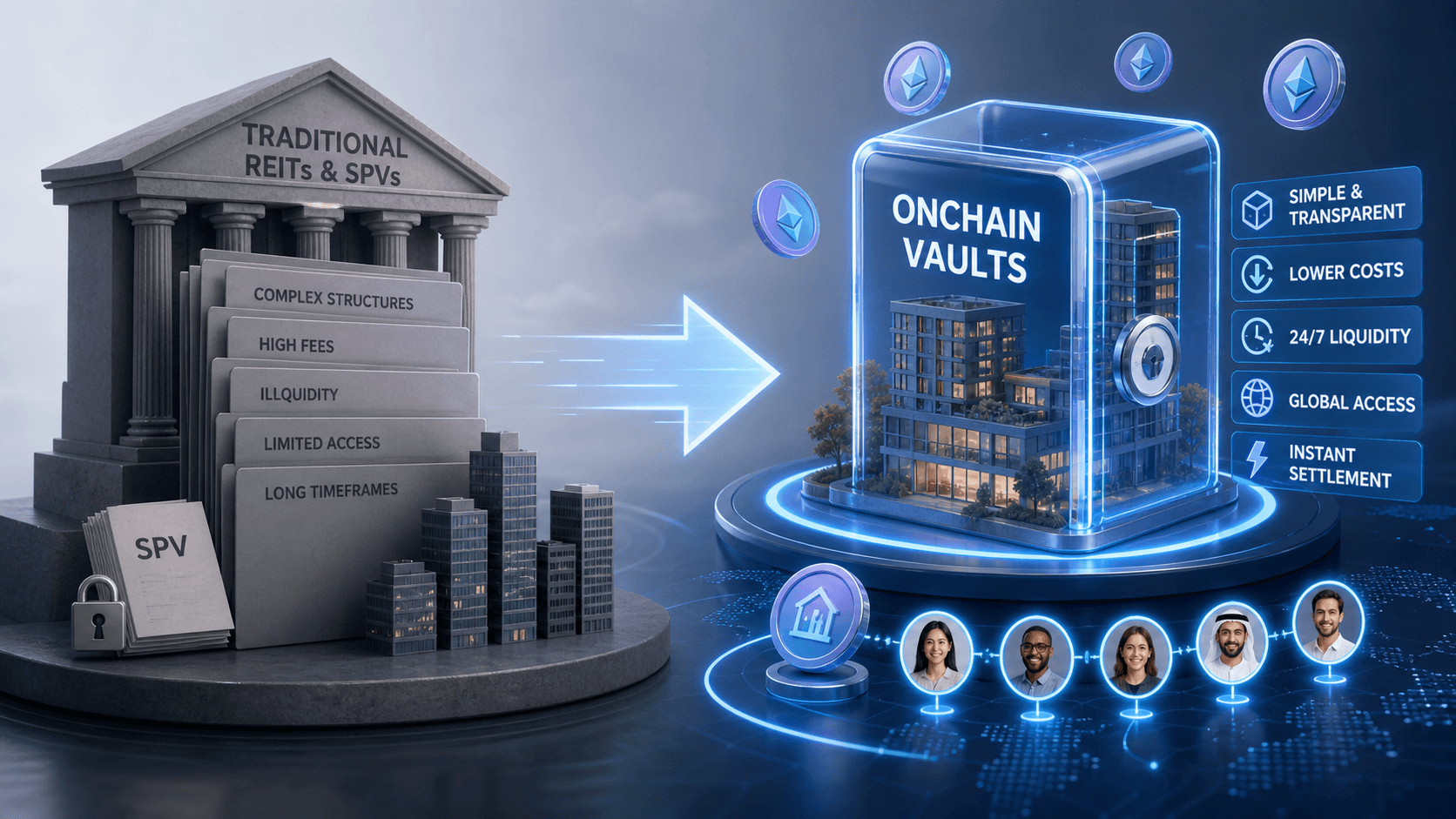
Tokenized real estate is not about replacing buildings or REIT structures—it’s about replacing the way they are managed, distributed, and governed. Instead of relying on spreadsheets, PDFs, and manual reconciliation, smart contracts let sponsors turn real estate into programmable, transparent, and self‑service products.
At RyzeX, our mission is simple: to sit between the legal reality of real estate and the programmable efficiency of onchain finance. By tokenizing REIT‑style portfolios and single‑asset SPVs or LLCs, we transform private real estate into a more scalable, liquid, and investor‑friendly asset class.
The cost of manual administration
Today, real estate is still run like 20th‑century finance. A sponsor places a property or portfolio inside a legal entity—often an SPV, LLC, or REIT‑style wrapper—and then manages it through a tower of disconnected systems:
Subscription documents circulate as PDFs via email.
Investors wire funds to bank accounts and wait for manual confirmation.
Transfer agents maintain private cap tables in internal databases.
Finance teams calculate distributions from spreadsheets, then trigger bank payments.
Compliance teams review each transfer after the fact, often with manual checks.
Each step adds friction, time, and cost. Launching a new vehicle can take weeks or even months. Every subscription, transfer, or redemption requires coordination between lawyers, admins, custodians, and compliance teams. Reporting is periodic and opaque, so investors must trust statements instead of independently verifying activity.
This “cost of manual administration” shows up in longer timelines, higher per‑investor fees, slower approvals, and more room for errors. For sponsors, it also means the more investors they add, the more administrative overhead grows—making fractional or cross‑border distribution harder, not easier.
What onchain tokenization replaces
Onchain real estate does not remove the legal wrapper; it replaces the operating stack around it. The property still sits in a REIT, SPV, or LLC, but the economic interests in that entity are represented by digital tokens issued via an onchain platform such as RyzeX. Those tokens become the live ownership register, and the smart contracts enforce how they can be held, transferred, and redeemed under the rules set by the issuer.
Here is what moves from the manual world into code:
Cap table maintenance → Onchain token ledger
Subscription and redemption requests → Onchain request and claim interface
Distribution calculations → Automated payout rules tied to cash‑flow events
Transfer restrictions and compliance checks → Onchain whitelists and access controls
Reporting and statements → Public, onchain transaction history plus optional enhanced dashboards
Instead of juggling spreadsheets, PDFs, and private databases, the issuer works with a single, programmable layer that records every change in ownership, every subscription, and every distribution as verifiable events on a blockchain. That’s the core shift: the same legal structure, but a different execution layer.
The smart contract as operations hub
In a tokenized real estate stack, the smart contract becomes the operations hub. It is not just a “digital share registry”; it is the central engine that coordinates subscriptions, valuations, redemptions, and distributions while respecting compliance and governance rules.
For a typical property‑backed product, the flow looks like this:
Subscription
Investors are approved via KYC and compliance checks.
The onchain layer accepts subscription requests, often in a typed, timestamped format (e.g., “request to subscribe X tokens at the next valuation point”).
The smart contract records the request but does not immediately alter ownership; it waits for a defined valuation or settlement window.
Valuation and pricing
The sponsor or an oracle submits the latest net asset value (NAV) or asset‑level price once per cycle (e.g., weekly, monthly).
The smart contract applies that price to all pending subscription and redemption requests at the same, transparent valuation point.
Settlement and claim
After valuation, the smart contract settles all batched requests and updates token balances.
Investors then “claim” their tokens or proceeds, which are released automatically if the pricing and eligibility rules are met.
Distributions and redemptions
Rental income or exit proceeds flow into the legal wrapper (SPV/LLC/REIT).
The smart contract then distributes tokens or cash to holders based on their pro‑rata economic interest, either as onchain payouts or as chain‑linked instructions to off‑chain systems.
Authorized redemptions follow the same request‑settle‑claim pattern, with the sponsor retaining control over liquidity scheduling and investor exit timing.
Because the smart contract enforces who can subscribe, who can trade, and how cash flows are distributed, it effectively replaces much of the manual fund‑administration logic that today lives in spreadsheets, emails, and internal procedures. Compliance rules, jurisdiction‑specific restrictions, and investor classes can all be encoded as permissions and whitelists, reducing the need for after‑the‑fact checks.
What changes in practice
To see how big this shift is, consider the same functions in traditional real estate vehicles versus their onchain equivalents:
Function | Traditional REIT / SPV / LLC | Onchain tokenized real estate (RyzeX‑style system) |
|---|---|---|
Launch time | Weeks to months (legal, admin, bank setup, cap‑table config) | Significantly shorter (legal wrapper + onchain issuance layer reuse) |
Subscription routing | Manual onboarding, bank wires, PDFs, internal intake forms | Onchain request flow with KYC/AML checks and automated booking into the next valuation window |
Ownership record | Private cap table in spreadsheets or transfer‑agent systems | Onchain token ledger; ownership is transparent and verifiable |
Transfer control | Manual approvals, compliance checks, and post‑facto monitoring | Onchain whitelists, role‑based permissions, and defined transfer rules |
Valuation & pricing | Periodic NAV published; subscriptions priced at discrete points via manual reconciliation | Programmable valuation windows; all requests are priced at the same, onchain‑recorded NAV point |
Distributions | Manual calculations in spreadsheets, bank or agent‑driven payouts | Automated distribution rules driven by onchain events or submitted cash‑flow data |
Redemptions | Manual gates, spreadsheets, and ad‑hoc processes; often slow and opaque | Request‑settle‑claim pattern; redemptions batched and settled at defined liquidity points |
Reporting to investors | Quarterly or monthly PDF statements | Real‑time inspection of token balances, transfers, and events on‑chain, with optional enhanced dashboards |
Operational overhead | High per‑investor cost; scales poorly with more investors or properties | Lower marginal cost per investor; core logic reused across multiple tokenized assets |
In practice, the sponsor still manages the asset, handles legal and regulatory compliance, and may still work with custodians or banks for fiat cash flows. But the repetitive, manual, and reconciliation‑heavy parts of the operation—cap‑table management, distribution logic, and basic transfer controls—shift into onchain code. That’s where the efficiency gains come from: not by removing roles, but by turning them into software‑assisted workflows.
Why having self‑controlled LLC‑based vault systems matters
One of the most powerful patterns in tokenized real‑estate design is the self‑controlled LLC‑based vault system. Instead of relying on a third‑party custodian or platform to “hold” the asset, the sponsor structures the economics so that:
A single‑property LLC or SPV holds the underlying real estate.
The economic interests in that entity are represented by onchain tokens issued to investors.
The smart contract controls how those tokens are issued, transferred, redeemed, and distributed, while the legal entity remains the owner of record for the property.
This setup gives sponsors several advantages:
Control and autonomy
The sponsor does not need to surrender control of the asset to a platform. The LLC or SPV remains the legal owner; the tokenization layer is just the distribution and servicing layer.Regulatory clarity
By keeping the property inside a familiar corporate wrapper (LLC/SPV/REIT), the structure can be aligned with local laws and tax regimes. Regulators see an entity that owns real estate; they do not need to treat the underlying asset itself as “onchain” in a legal sense.Product‑like flexibility
Each LLC‑backed property can be turned into a standardized token product. The same issuance, compliance, and lifecycle logic can be reused across multiple properties, turning a portfolio of SPVs into a programmable product suite rather than a collection of one‑off private deals.Custody and risk separation
The asset stays in the legal entity, while the tokens live onchain. This separation helps align with custody regulations: the sponsor controls the entity and the property, while the tokens can be held in investor‑controlled wallets or institutional custodians on the blockchain layer.
For RyzeX, this model is especially powerful. It can act as the issuance and operations layer across multiple LLC‑based vaults, standardizing how subscriptions, redemptions, distributions, and compliance controls work while letting sponsors keep their preferred legal and tax structures. Over time, this creates a clear distinction:
Legal ownership stays in the LLC/SPV/REIT.
Investor economics and operations live onchain, in code.
Ready to tokenize your next real‑estate vehicle?
If you’re a sponsor, REIT manager, or SPV operator, the biggest shift is mindset: don’t treat tokenization as a marketing gimmick, but as operations infrastructure.
With RyzeX, you can start by tokenizing a single LLC‑based asset, reuse the same issuance and compliance logic across multiple properties, and gradually turn your real‑estate portfolio into a programmable, onchain‑native product suite.
The buildings stay the same. The way you manage, distribute, and service them doesn’t.
Want to see how onchain real‑estate infrastructure works in practice? Explore the RyzeX documentation to review tokenized vault architecture, issuer and investor roles, compliance controls, and distribution mechanics for REITs and LLC‑based SPVs.
Stay informed with the latest guides and news.